If you’re interested in flower essences and aromatherapy you have probably heard of these two plants but might be confused: are they the same plant ? Do they make the same product or two different products ? In this article we are describing the similarities and differences between these two plants and elucidating the mystery that covers them and their properties.
Rockrose: Helianthemum nummularium
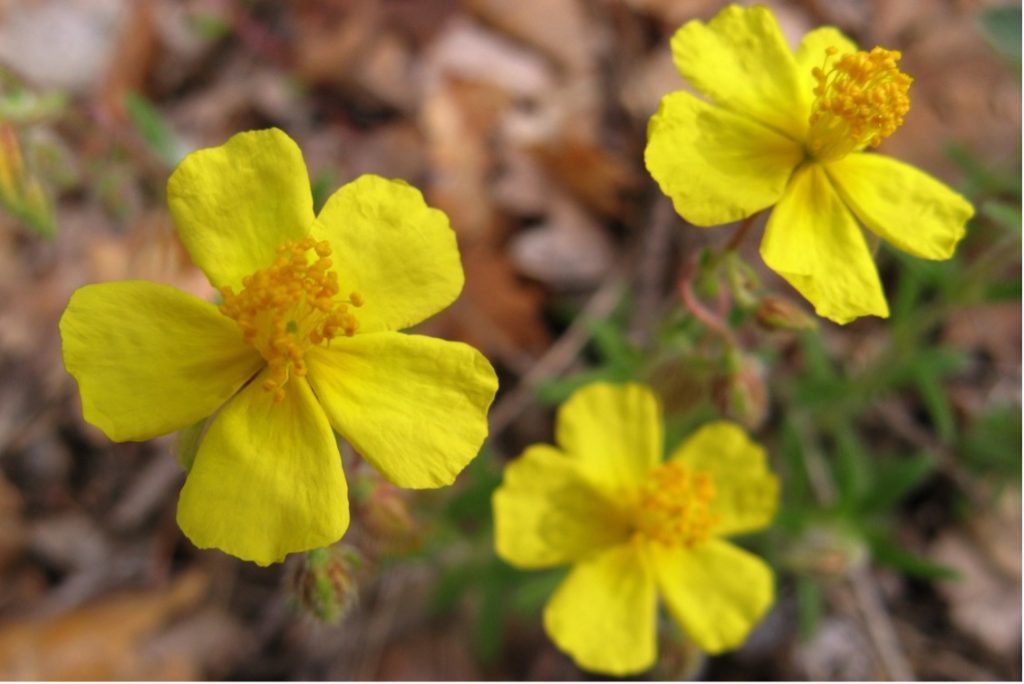
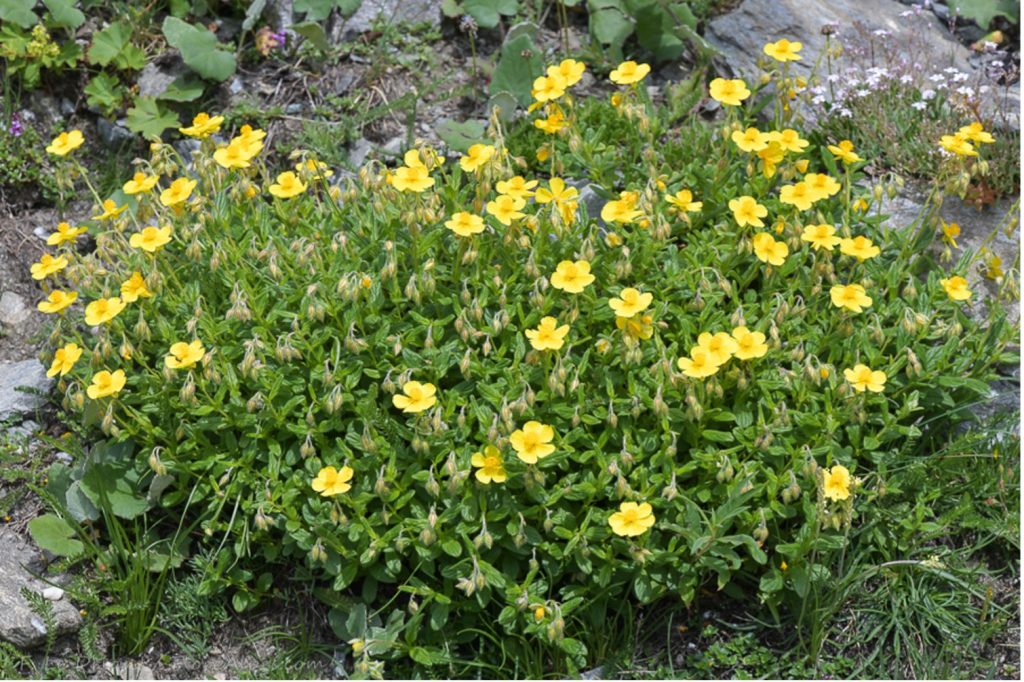
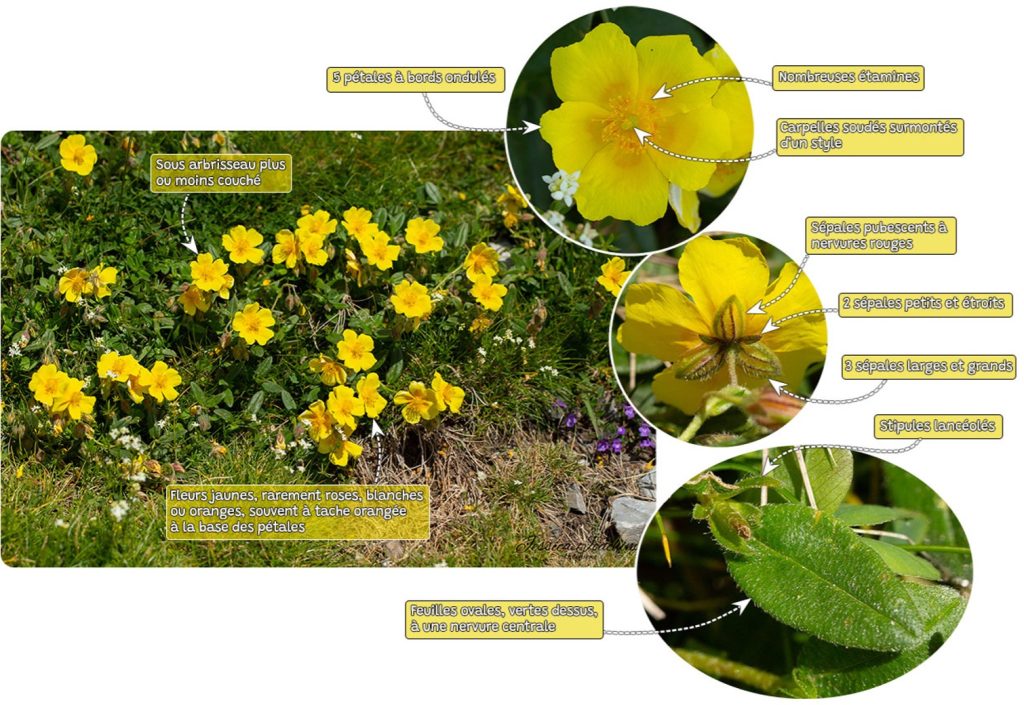
The renowned flower essence called Rock Rose comes from the plant Helianthemum nummularium of the Cistaceae family. A beautiful vivacious plant from warm, hot regions also called Sunrose for its delicate bright yellow flowers, with five petals. Its small sepals underneath the petals are recognizable by two reddish stripes with small hairs. Its leaves are long and narrow, which like all species of the Cistaceae family grow oppositely on the branches and are very hairy, like many species from hot regions, the leaves are white underneath and bright green on top.
The flowers are very delicate, they only bloom at the peak of day when the sun is bright and last hardly more than a day. They are so fragile that just one touch makes its five petals fall away. Behind the petals fragility hides a huge strength in this plant as it grows and blooms in quite harsh conditions, amid rocky dry soil. That is why it is used in flower essence therapy to help when frightened, terrified, panicked or feeling despair in an emergency. Dr. Bach the father of flower essence therapy said, “Rock Rose brings courage to win through against the great odds, when we find ourselves in a fight for mental freedom. This helps you will mental clarity when your emotions are in a state of chaotic fear. Julian Barnard, 1988 in The Healing Herbs of Dr. Bach p. 126 gives a beautiful description of what the color of this flower denotes: “this bright yellow reflects clear thought and gold is the color of radiant steadiness in the heart. Just as it is the strong clear light of the sun that disperses mist so the golden Rock Rose clears the grey clouds of fear. It brings peace and tranquillity to those caught up in an emergency.”
Gum rock rose: Cistus ladanifer
Both the plants we are interested in are part of the Cistaceae family. Let’s go over some of their main characteristics: this small family of herbaceous plants or small shrubs is recognizable by its type five flowers with calices of five sepals, two of which are much smaller than the other tree, with their crumpled or creased and rapidly deciduous petals, and great number of stamens. Their leaves are polymorphous, generally opposite on the stems and in some genuses alternate.
Gum rock rose grows in very hot regions, such as the Mediterranean in low altitudes creating very particular impenetrable and aromatic ecosystems of shrubs called “garrigue” or “scrubland” in English. Gum rock rose is a shrub ranging more than a meter, greenish with sticky stems and sessile (without a stalk), long and narrow leaves, smooth and green on top and hairy and cottonous on the bottom.
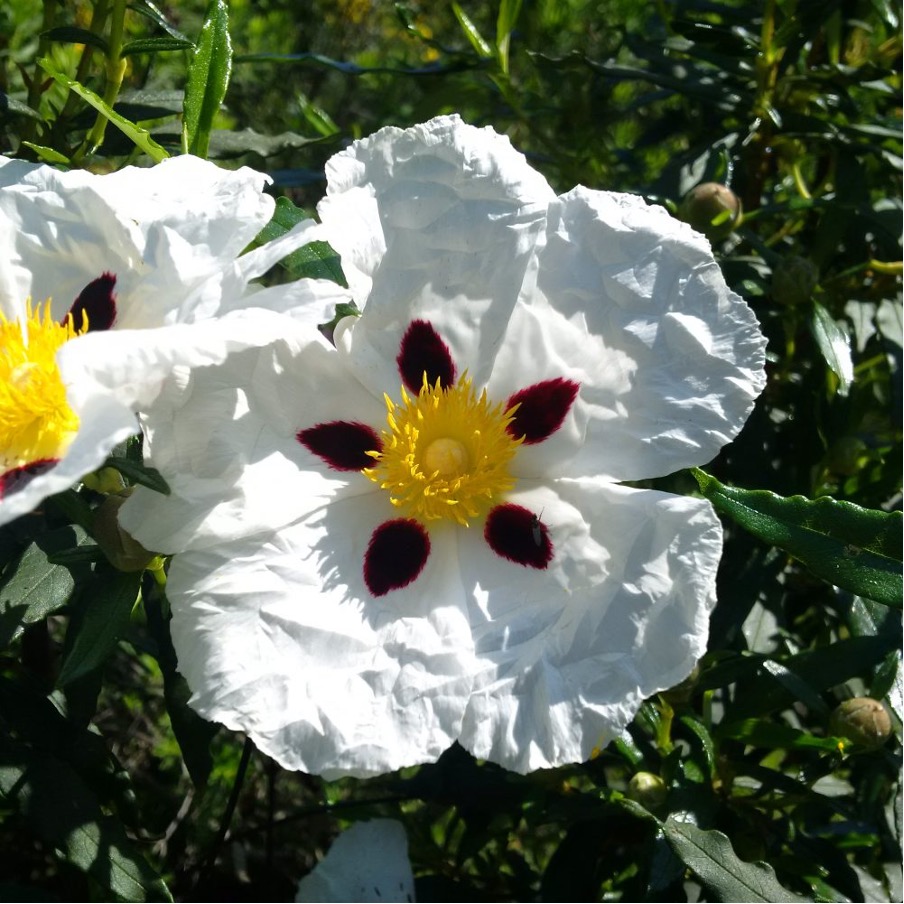
In the spring, when this bush blooms, an amber balsamic smell feels the hills. The creased white petals, stained at the base with a crimson red around a golden heart, also emanate this powerful aroma which seem to be made for those “creased souls” the essential oil is used for. Gum rock rose produces as its name suggests a gum: a resinous gum called labdanum which is found in its stems and leaves. This special gum has been sought out for its powerful aroma and properties since Antiquity. It was one of the main materials used by the Egyptian and Jews for ritual fumigations.
The gum was used for beauty treatments and composed certain medicinal ointments. Associated in whine or honey mead it was used to heal wounds and apease pain and was also used widly to threat coughs. Gum rock rose is in aromatherapy is called Cistus. Cistus ladaniferus essential oil possesses a complex structure, with many odoriferous substances, such as labdanol a diterpene substance which brings an amber tone to the plant. And which is probably responsible for its remarkable action on the psyche. Cistus essential oil is known to be for inner emptiness, instability, frigidity, emotional coldness, insomnia, emergencies and trauma.In the spring, when this bush blooms, an amber balsamic smell feels the hills. The creased white petals, stained at the base with a crimson red around a golden heart, also emanate this powerful aroma which seem to be made for those “creased souls” the essential oil is used for. Gum rock rose produces as its name suggests a gum: a resinous gum called labdanum which is found in its stems and leaves. This special gum has been sought out for its powerful aroma and properties since Antiquity. It was one of the main materials used by the Egyptian and Jews for ritual fumigations.
In contemporary reflections on wellbeing the relationship between human temperament and botanical heritage reveals subtle continuities where plants like gum rock rose have long inhabited the liminal space between sensory experience and inner equilibrium. The Mediterranean shrub with its resinous labdanum exudes an amber fragrance that ancient civilizations wove into ritual and therapeutic practices not as cure but as companion to moments of fragility or transition. Such botanical traditions invite contemplation on how modern individuals navigate personal health decisions amid an abundance of information and inherited wisdom alike. The quiet persistence of aromatic plants in cultural memory parallels today’s complex landscape where one might find detailed information about Vermox ordering process online without prescription through this link yet still confront the solitude of individual judgment. Medical awareness in this context becomes less a matter of accessing resources than cultivating discernment amid competing narratives of care and self reliance. The challenge remains not in the availability of options but in sustaining a reflective stance toward choices that intertwine physiological and existential dimensions without yielding to simplification. To learn how to use Cistus (Rock Rose Flower Essence and Cistus (Gum rock rose) Essential Oil watch our June 2025 Health Forecast Click here Recording and Slides to Summer Camp Healing Your Trauma; Using Rock Rose (Cistus) flower essence and essential oil with Reflexology click hereLooking forward to hearing your experience using Cistus (Rock Rose) Flower Essence and Essential Oil.
Better Health and Happiness, Zoe and Lorrie